Real-source case: ClinVar germline classifications, three years later
The second real-data case moves from ontology names to clinical genetics. It asks whether a declarative profile can express a real curation policy from atomic evidence, and whether the validator's decisions in 2023 correspond to what happened to those classifications by 2026. It uses the generic engine unchanged; all ClinVar-specific logic is in this folder.
Not for clinical use. ClinVar is not intended for direct diagnostic use, and neither is this benchmark. "Stable for three years" does not mean "correct".
Run offline
From the repository root after uv sync --frozen --extra dev (about 30 seconds):
uv run python examples/clinvar_germline/run.py --output artifacts/clinvar
Runtime needs only the frozen 361 KB sample in sources/; its decompressed content hash is
checked before ingestion. Two runs produce byte-identical outputs. Committed
results include summary.json, summary.md, divergences.csv
(every case where the validator and NCBI disagree) and faults.jsonl (every controlled-fault
and trust-boundary case, used by the error taxonomy).
Source and selection
Evidence comes from the ClinVar 2023-09 monthly release; outcomes from the 2026-09 release. See attribution, terms and upstream hashes.
The population is every 2023-09 variant whose aggregate germline classification is Pathogenic,
Likely pathogenic or Pathogenic/Likely pathogenic, with OriginSimple = germline
(218,920 variants). The sample stratifies it by NCBI's 2023-09 aggregate review status and
takes the first 1,000 per stratum after ordering by SHA-256(bioai-clinvar-v1: + VariationID):
| Stratum | NCBI 2023-09 review status | Stars | Sampled |
|---|---|---|---|
no_criteria |
no assertion criteria provided | 0 | 1,000 |
single_submitter |
criteria provided, single submitter | 1 | 1,000 |
multiple_submitters |
criteria provided, multiple submitters, no conflicts | 2 | 1,000 |
expert_panel |
reviewed by expert panel | 3 | 1,000 |
practice_guideline |
practice guideline | 4 | 26 (all) |
conflicting |
criteria provided, conflicting interpretations (with a criteria-based P/LP submission) | – | 1,000 |
From ClinVar submissions to evidence records
One record per variant proposes "variant has a germline pathogenic or likely pathogenic classification". Each 2023-09 submission (SCV) becomes one evidence item, imported by a deterministic parser:
| Submission review status | Evidence type |
|---|---|
| criteria provided, single submitter; reviewed by expert panel; practice guideline | criteria_based_classification |
| no assertion criteria provided | classification_without_criteria |
| no assertion provided | record_without_classification |
Direction comes from the submission's classification: Pathogenic / Likely pathogenic (including low penetrance) supports; Uncertain significance, Likely benign and Benign contradict; anything else (risk alleles, drug response, other) is neutral. Unknown review statuses fail the import. These mappings were fixed before any results were seen.
The importer adds two transparent aggregate items, listing the SCVs they rest on:
multi_submitter_or_expert_review (at least two distinct submitters with criteria-based P/LP
submissions, or an expert-panel / practice-guideline P/LP submission) and expert_review.
The importer never decides what dissent means; the engine does.
The profile has three uses:
| Use | Required evidence types |
|---|---|
research_summary |
criteria_based_classification |
clinical_reference |
criteria_based_classification, multi_submitter_or_expert_review |
expert_reference |
criteria_based_classification, expert_review |
Any contradicting line sends every use to review (BEV004). Unlike ClinVar's aggregation,
the generic engine does not ignore dissent that lacks assertion criteria, and it has no rule
that lets an expert panel override lab submissions.
Evaluation protocol
| Cohort | Construction | Reference | What it measures |
|---|---|---|---|
| A. Policy reproduction | All 5,026 sampled variants × 3 uses | NCBI's own 2023-09 review status (0★ → no use; ≥1★ research; ≥2★ clinical; ≥3★ expert; conflicting → none) | Whether a profile plus a transparent importer reproduces an independently implemented policy |
| B. Three-year stability | The 4,026 sampled 2023-09 P/LP variants, and separately the whole population | NCBI's 2026-09 aggregate classification | Whether 2023 decisions correspond to later conflict or downgrade |
| C. Controlled faults | 16 seeds admitted for all uses × 10 specified faults | Authored fault specifications | Detection of injected contract violations |
| D. Trust boundary | 16 no-criteria variants relabeled with a fabricated expert review; 16 expert-panel variants with their dissenting submissions removed | Fabricated review: rejected; omitted dissent: review | What only the source can show: the rules alone admit these, grounding should not |
Cohorts C and D are validated twice: by the full validator, and by the full validator with
source grounding. ClinVarGrounder rebuilds the
variant's evidence from the pinned sample and compares the record with it item by item:
each cited submission must exist (BEV016) and match its review status, content, scope and
direction; each derived aggregate must match the one recomputed from the submissions
(BEV017); and a submission the record leaves out sends it to review (BEV018). Extraction
methods are not compared; they describe how the record was made, not what the source says.
The run also checks that grounding changes none of the 5,026 real-source decisions.
Destabilized means the 2026-09 aggregate classification is conflicting, or includes Uncertain significance, Likely benign or Benign. Variants missing from 2026-09 or with other classifications (e.g. risk allele only) are reported but excluded from denominators. Intervals are Wilson 95%. The sample strata are equal-sized, so pooled sample rates are not population rates; population rates come from all 218,920 variants.
Observed results
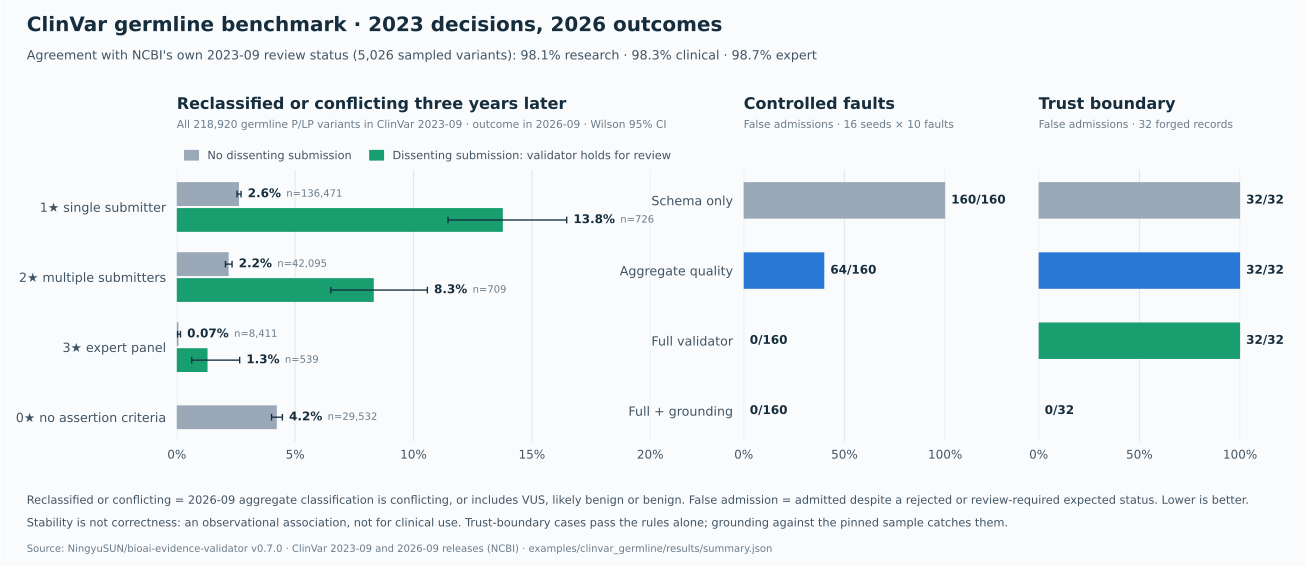
A. The profile reproduces NCBI's policy on 98–99% of decisions, and every disagreement has a documented cause:
| Use | Agreement | Validator stricter | Validator looser |
|---|---|---|---|
research_summary |
4,932 / 5,026 | 93 | 1 |
clinical_reference |
4,941 / 5,026 | 85 | 0 |
expert_reference |
4,960 / 5,026 | 66 | 0 |
- Stricter, dissent (
BEV004): 1★ and 2★ variants carrying a dissenting submission without assertion criteria (which NCBI ignores), and expert-panel variants with dissenting lab submissions (which NCBI lets the panel override). - Stricter, source inconsistency (1 case, VariationID 1473602): the 2023-09 variant summary reports two submitters, but the same release's submission file lists one SCV.
- Looser (1 case, VariationID 872752): the only dissent is "Uncertain risk allele", which the pre-registered mapping treats as neutral; NCBI counted it as a conflict. Not tuned after the fact.
B. Where the validator is stricter than NCBI, classifications were far less stable. All 2023-09 germline P/LP variants, share destabilized by 2026-09:
| 2023-09 review status | Without a dissenting submission | With a dissenting submission (validator: review) |
|---|---|---|
| 1★ single submitter | 3,587 / 136,471 = 2.63% (2.54–2.71) | 100 / 726 = 13.77% (11.46–16.47) |
| 2★ multiple submitters | 922 / 42,095 = 2.19% (2.05–2.33) | 59 / 709 = 8.32% (6.51–10.59) |
| 3★ expert panel | 6 / 8,411 = 0.07% (0.03–0.16) | 7 / 539 = 1.30% (0.63–2.66) |
| 0★ no assertion criteria | 1,248 / 29,532 = 4.23% (4.00–4.46) | – |
In the sample, decisions for stricter uses map to lower later instability:
| Use | Admitted in 2023 | Not admitted in 2023 |
|---|---|---|
research_summary |
43 / 2,933 = 1.47% (1.09–1.97) | 53 / 1,083 = 4.89% (3.76–6.35) |
clinical_reference |
16 / 1,941 = 0.82% (0.51–1.33) | 80 / 2,075 = 3.86% (3.11–4.77) |
expert_reference |
0 / 960 = 0.00% (0.00–0.40) | 96 / 3,056 = 3.14% (2.58–3.82) |
Concordance between submitters is a weak signal on its own (2★ 2.19% vs 1★ 2.63% without dissent); expert review and the absence of any dissent are strong ones.
C/D. Controlled faults: false admissions 160/160 schema-only, 64/160 with the pre-0.4.1 aggregate quality gate, 0/160 full (80 review, 80 rejected), matching the VBO case. With grounding, the 16 injected dissents are rejected rather than reviewed, since the dissenting submission they cite does not exist in ClinVar (BEV016); no controlled fault is admitted.
| Trust-boundary control | Schema-only | Aggregate quality | Full | Full + grounding |
|---|---|---|---|---|
| Fabricated expert review (expected: rejected) | 16/16 | 16/16 | 16/16 | 0/16 |
| Omitted dissent (expected: review) | 16/16 | 16/16 | 16/16 | 0/16 |
The rules alone admit every trust-boundary case: a record that mislabels its evidence or leaves out the dissent consistently looks sound. Grounding against the pinned sample rejects all 16 fabricated reviews (BEV017) and sends all 16 records with omitted dissent to review (BEV018), without changing any of the 5,026 real-source decisions.
Interpretation limits
- Stability is not correctness. A classification can be stable and wrong, or change for reasons unrelated to evidence quality (new submitters, reinterpretation of guidelines).
- Not independent of ClinVar. Review tiers shape which variants attract later submissions and expert curation; the association in B is observational, not causal.
- Reference labels are not expert annotations. Cohort A compares against NCBI's automated aggregation. No independent human review of these variants has been done.
- Scope. One registry, germline P/LP classifications only, one three-year window. Condition (disease) identity is not modeled; ClinVar's aggregate classification is per variant.
Rebuild from original bytes
Download the three upstream files listed in sources/README.md, keeping the exact bytes, then:
uv run python examples/clinvar_germline/prepare_source.py \
  --submission-summary-2023-09 submission_summary_2023-09.txt.gz \
  --variant-summary-2023-09 variant_summary_2023-09.txt.gz \
  --variant-summary-2026-09 variant_summary_2026-09.txt.gz \
  --retrieved-at 2026-09-25T06:42:53Z --output artifacts/clinvar-rebuilt
The script verifies each file's size and SHA-256 before reading it, then reproduces the sample (identical decompressed content hash), the population table and the manifest.
Regenerate the figure
The figure is drawn from results/summary.json only:
uv run --with matplotlib python examples/clinvar_germline/plot.py
It writes docs/assets/clinvar_germline_benchmark.svg with fixed SVG ids and no timestamp,
so a given matplotlib version reproduces it byte-for-byte (committed with matplotlib 3.11.2).
Colors were checked for color-vision-deficiency and normal-vision separation on the figure's
background; every bar also carries its value as text.